By DRBU Staff VBS 675
Chinese Translated by Janet Lee
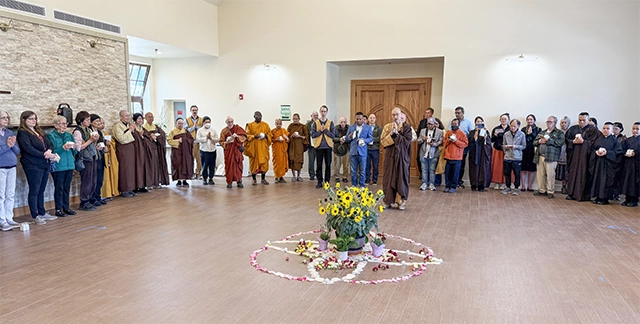
On the morning of May 23, 2026, Dharma Realm Buddhist University (DRBU) marked its 50th anniversary with a gathering in the Earth Treasury Hall at the City of Ten Thousand Buddhas. Over one hundred people—including students, alumni, faculty, staff, family members, and friends from Ukiah and from abroad—came together to hear from senior disciples who were present at the University’s founding and who studied under DRBU’s founder, the Venerable Master Hsuan Hua. In addition, two honored guests joined the gathering: Venerable Bhikkhu Bodhi, whose translations of the Pāli canon are read at DRBU and around the world, and Bhante Buddharakkhita, a pioneering Ugandan monk who has established a major Buddhist center in his home country.
2026年5月23日上午,法界佛教大學(法大)於萬佛城地藏殿舉行五十週年校慶。逾百位嘉賓齊聚一堂,包括學生、校友、教職員、家屬,以及來自瑜伽市與海外的朋友,共同聆聽上人老弟子們的心得分享。這些老弟子曾親炙宣公上人教誨,見證法大的創建歷程。校慶亦迎來兩位特別嘉賓:菩提比丘尊者,其巴利三藏譯作在法界佛教大學及全球廣為閱讀;以及佛護比丘,為非洲烏干達首位僧人,已在故鄉建立大型佛教中心。
DRBU President Doug Powers began by welcoming everyone and shared his own reflections about Master Hua’s intentions for DRBU from his experience as an early disciple. “Master Hua had this incredibly huge vision of what humanity needed,” he said, “and in order to bring that vision to fruition, we have to create institutions to do it. It’s not a matter of just sitting in meditation. No matter what we can achieve in our own cultivation, it has to be brought out into the larger world.” When he asked Master Hua what he had in mind for the university, he recalled him saying that it’s like bringing Buddhism to Harvard or MIT. It isn’t necessarily changing the subjects that are taught, but it’s about bringing an ethical, humanistic, liberal kind of foundation to all subject matters, so that people go out into the world, in every field they’re in, with an ethical foundation. He shared: “The success of the university is not numbers, but the quality of the students,” adding, “the quality of the students that we have is incredible. I really appreciate every single student here.”
法界佛教大學校長鮑果勒首先向與會者表達誠摯的歡迎,並分享他身為早期弟子對宣公上人創校理念的體悟。他指出,上人對人類需求懷有極其宏偉的願景,而要落實此願景,必須建立相應的教育殿堂。「這不僅僅是靜坐修持的問題;無論我們在自身修行中達到何種境界,都必須將其推展至更廣大的世界中。」他回憶曾請示上人對法大的構想,上人回答說,這就如同將佛教帶入哈佛或麻省理工學院,目的並非要改變所教授的科目,而是為所有學科注入倫理、人文與博雅的根柢,使學子在投身社會各領域時,皆能具備堅實的道德底蘊。鮑校長強調:「大學的成就不在於人數,而在於學子的修養。」並補充道:「我們的學子品質極為卓越,我由衷感謝在座的每一位學生。」
Dean Emeritus Martin Verhoeven followed. Professor Verhoeven shared that when they sat down to start the current program that is now accredited, they drew from five elements of their learning experience under Master Hua and tried to crystallize these elements into institutional form. The five elements were:
終身榮譽教務長馬汀•維荷文教授隨後發言。他回顧,在設計如今已獲得認證的學程時,他們汲取了在宣公上人座下修學的五大要素,並嘗試將其制度化,以落實於校院之中。這五大要素為:
1. Living and studying in an environment imbued with shila or precepts
2. Close and slow reading of primary texts. Seeing these texts actually as living beings and close friends we were swimming with
3. Translation of these texts into languages, starting with English, but expanding to all the major languages in the world
4. Contemplative immersion that involves close self-reflection and self-cultivation and immersion in the three non-outflow studies: Shila, Samadhi, and Prajna
5. Transformative shifting or reconfiguring, as a result of cleansing the afflictions. You became totally different than what you were, and that grew out of all of the above coming together.
一、在持戒的氛圍中生活與學習。
二、對主要經典進行深入而細緻的研讀,並將其視為眾生與善友,同游法海。
三、將經典翻譯成多種語文,首先是英文,並逐步拓展至世界所有主要語言。
四、透過自我觀照與修持,深入戒、定、慧三無漏學。
五、由煩惱的轉化而產生徹底的改變,使身心煥然一新,這正是上述要素融合的成果。
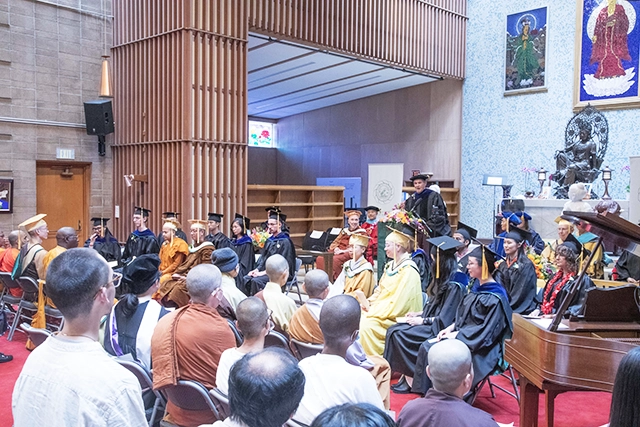
He continued: DRBU’s approach is based on a timeless model of education rooted in the Latin educere—to draw out, to pull out, to lead out of the person from within. There’s an innate potential in the person for understanding, for wisdom, for insight, and for really wholesome action. And so, you actually want to bring that out and develop it. Master Hua called it activating or developing inherent wisdom. And so, all of DRBU’s courses, the whole pedagogy of the program, is meant to bring this out and to develop it from within. The result of that is basically DRBU is not just a series of courses; it’s not even a philosophical way of thinking, it’s a way of being a person.
他進一步說明,法大的教育理念奠基於「跨時代的教育模式」,源自拉丁文 educere,意指「引出、帶出、由內而生」。此一理念認為,人的內在本就蘊含理解、智慧、洞察力與善行的潛能,教育的宗旨即在於引導並培養這些潛能。宣公上人稱之為「主觀智能推動力」。因此,法大的所有課程與教學方法皆以滋養此種內在力量為核心,教育成果不僅止於學分累積,更超越一般哲學思維訓練,而是形塑「為人之道」的實踐模式。
The third speaker was Dean of Students Dharma Master Heng Liang. DM Liang has worked primarily as an administrator for DRBU over the years, and because of her efforts the University has remained in official standing. She spoke about Master Hua’s four legacies, one of which is education, and about how he saw a need to reform education—because even in his time, education was not what it should be.
第三位發言的是學務長恒良法師。多年來,她主要擔任法界佛教大學的行政工作,確保法大持續維持正式立案的地位。恒良法師談到宣公上人的四大志業,其中之一便是教育。她指出,上人洞察當時教育已失去應有的面貌,因而深感教育改革的必要性。
In the second half of the event, participants broke into smaller circles for discussions with senior disciples, faculty, and staff. The event closed with a ceremony in which each participant placed a flower into a mandala offering their good wishes, and received a handmade candle and handmade cookies to take home.
在活動後半段,與會者分組座談,與老弟子、教師及職員交流心得。隨後,活動於一場溫馨儀式中圓滿落幕:每位參加者將一朵花置入曼荼羅,以寄託美好祝願,並獲贈手工蠟燭與餅乾作為紀念。
Spring Contemplative Immersion: Noble Friendship
春季觀照實修:善知識
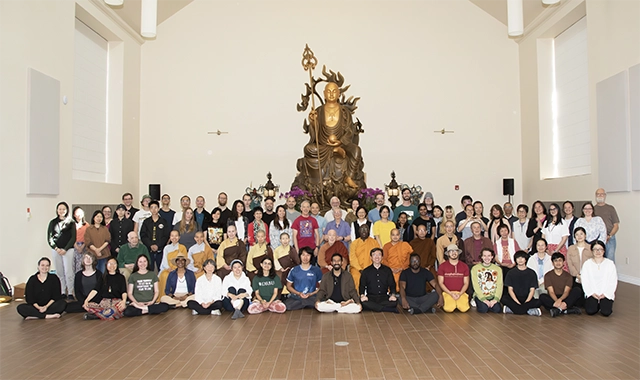
The week preceding the anniversary celebration, Venerable Bhikkhu Bodhi led DRBU’s spring contemplative exercise immersion (CEI), during which all regular classes were suspended and students took part in a week-long immersion in contemplative practice. This semester’s topic was “Noble Friendship: Nurturing a Harmonious Community.”
在校慶前一週,法界佛教大學舉行春季「觀照實修週」,由菩提比丘尊者親自帶領。在此期間,所有常規課程暫停,學生全程投入為期一週的觀照修習沉浸體驗。本學期主題為:「與善友同行:涵養內外和諧之道」。
In his first lecture of the week, Venerable Bhikkhu Bodhi said, “The Buddha places very special emphasis on one’s choice of friends. He sees this having a profound influence on one’s individual development. It is conducive to one’s own inner spiritual development and it is conducive to the creation of a harmonious and ethically upright community.”
在該週首場的講座中,菩提比丘尊者闡述佛陀對「交友之道」的重視。他強調,友伴的選擇對個人成長具有深遠影響,不僅促進內在靈性的培養,更有助於建構一個和諧且倫理健全的社群。
He offered an analogy of tuning a musical instrument such as a guitar. If you have an untuned guitar, you listen to the sound of a well-tuned guitar, and you loosen or tighten the strings on your own guitar until it is properly tuned. You can say that the well-tuned guitar is like the good friend that you are emulating, that you are seeking to embody the qualities represented by that good friend. When you first start the spiritual life, you are like an untuned guitar, and you have to link up with somebody who embodies and represents those wonderful and excellent qualities that you are trying to develop, and you make the effort to develop those qualities within yourself.
在這場講座中,他以吉他調音作比喻,說明「善友」在修行道路上的重要性。他指出,若手中有一把未調音的吉他,便需透過聆聽一把調好音的吉他,來調整自己吉他的弦,直到音準正確。由此可見,善知識如同調好音的樂器,能成為效法的典範;初機修行者猶如未調音的吉他,需要親近德行兼備的善知識,努力培養自身德行與智慧。
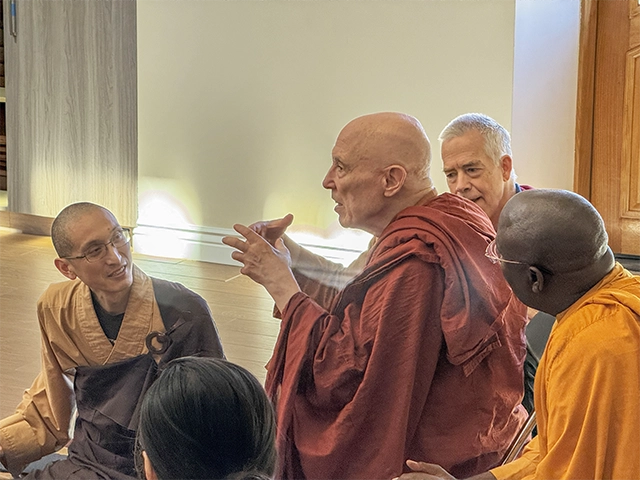
Bhante Buddharakkhita gave a talk during the same week on befriending yourself. As a child in Uganda, he recalled, he was afraid of the water after a cousin nearly drowned. While studying in India he had the chance to learn to swim, and later, in Thailand, he learned scuba diving. One day he slipped in the shower and cut open his jaw, requiring a trip to the hospital for stitches, and then he had to wear a large white bandage at his job as a scuba instructor. When his fellow instructors asked what had happened, he told the story smiling, with joy, and with the energy of someone who had befriended himself—so they assumed he must be joking about the whole thing. He stubbornly refuses, he said, to be too serious in life. In everything, in nature and in life, we need balance rather than extremes.
在同週的講座中,佛護比丘以「與自己為友」為題,分享了自身的生命經驗。他回憶童年在烏干達時,因表哥差點溺水而懼怕水域;在印度求學時學會游泳,後來在泰國更進一步學習水肺潛水。有一次,他在淋浴時滑倒摔破下顎,需要縫合治療,在潛水教練的工作中,得貼著一大塊白色繃帶。當同事詢問事故經過時,他以微笑、愉快的心情敘述,流露出與自己和解的能量,甚至讓人誤以為他在開玩笑。他強調,自己始終堅持不讓生活過於嚴肅;在人生與自然中,我們需要的是平衡,而非極端。♦