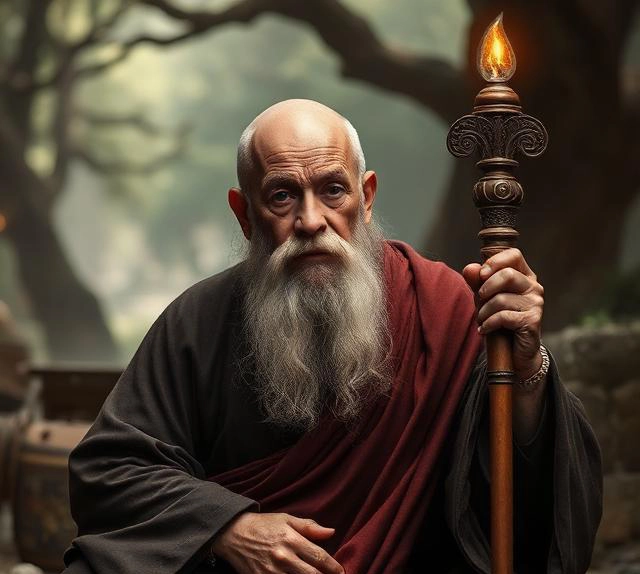
宣公上人講於一九八七年三月十四日 By Venerable Master Hua on March 14,1987
實叉難陀譯為喜學,唐于闐國人,精通三藏,為西域高僧也。賢首國師為武則天講華嚴經,帝感經義未周,遣使至于闐國求梵本,並禮請譯經法師。於證聖元年(公元六九五年),法師應聘至洛陽,於佛授寺譯華嚴經,參加者有義淨、法藏、日照諸法師。帝供養,有時將經文加以潤色。四年後。譯成八十卷,稱為唐譯本,帝為撰序。賢首國師宣講此經,至華藏世界海品時,道場震動。又譯地藏經等十餘種,重譯往生咒為十四句,有五十九字。法師於五十九歲時,示寂於長安。荼毘時,舌根不爛,證明所譯之經典不謬。後人建塔於長安,名為華嚴三藏塔。
Sikshananda translates as “Delight in Learning.” This Dharma Master was from Khotan (current Hetian, Xinjiang, China), and lived during the Tang Dynasty. He completely understood the Three Treasuries and was regarded as an eminent high monk from the Western Region[1] . When National Master Xianshou lectured the Avatamsaka Sutra for the Empress Wu Zetian, the Empress felt that the translated Sutra did not convey the complete meanings. Therefore she sent envoys to Khotan to acquire the Sanskrit version as well as to invite Dharma masters over to translate the sutra. In 695 A.D., a group of invited dharma masters arrived in Foshou (Buddha’s Bestowal Monastary,) Luoyang, China to undertake the translation of the Avatamsaka Sutra. Master Yijing, Master Fazang, and Master Rizhao participated in the translation. The Empress made offerings to them, and sometimes helped to polish the translations. After four years, they completed the translation which was compiled into eighty rolls, and referred to as the “Tang edition.” The Empress wrote the “Verse for Opening the Sutra.” When National Master Xianshou lectured up to Chapter 5, The Flower Store Sea of Worlds, the Bodhimanda trembled and quaked. Master Sikshananda also translated more than ten other Sutras including the Earth Store Sutra. He re-translated the Rebirth Mantra into the version with 59 words in 14 lines. When he was 59, he entered Stillness in Chang’an ( the current city of Xi’an). After his cremation, his tongue remained intact, proving that his translations were flawless. A stupa named Tripitaka Master Avatamsaka, was built in Chang’an to commemorate him.
贊曰 A verse in praise says:
唐朝中葉 武氏則天
雖有穢名 護法身先
重視佛教 禮請高賢
實叉難陀 八十華嚴
In the mid-Tang Dynasty,
Empress Wu Zetian,
Despite her sullied reputation,
Is a foremost Dharma-protector.
She highly values and esteems Buddhism,
Inviting and honoring noble and virtuous ones,
Including Master Sikshananda,
Who translates the 80-roll Avatamsaka.
又說偈曰 Another verse says:
于闐高僧蒞中原 大闡正法譯華嚴
重重無盡深如海 義義顯圓高比天
賢首講解感地震 清涼疏鈔照人間
九九卷末普賢願 虛空法界俱包含
A noble monk from Khotan reaches China,
Vastly expounding Proper Dharma, translating Avatamsaka;
Meanings endlessly layered, inexhaustible, and deep as sea,
Complete, perfect, well-rounded, higher than Heaven.
Master Xianshou lectures on it, ground trembling in response;
Master Qingliang writes Commentaries, illuminating the world.
Universal Worthy’s Vows is the 81st roll,
Encompassing empty space throughout the Dharma Realm.
【淺釋】Commentary:
佛教徒應該向前勇猛精進,不會的要會,不懂的要懂,常常對於講經說法要爭先恐後,不要人家叫你講也不講,總往後退,成佛的日子就很遙遠。若常常往前跑,那成佛的路就近了。
We disciples of the Buddha should move forward vigorously and bravely, strive to master what we have not mastered, and understand what we have not understood. We should take the initiative in lecturing Sutras and expounding the Dharma – strive to be the first and fear to be the last. Whenever requested to speak Dharma, we should step forward and not always refuse. Otherwise, it will take forever for us to realize Buddhahood. If we do keep moving forward, we would be closer to Buddhahood.
今天講的實叉難陀法師是于闐國(即今新疆)人。他精通經、律、論三藏,在于闐國當時是一位很聰明有智慧的法師。其名字中文譯為「喜學」,歡喜學習,大概他一點煩惱也沒有,無論受什麼困苦艱難,他都高興,所以這位法師是很難得的。
Dharma Master Sikshananda whom we are talking about today was from Khotan (current Hetian, Xinjiang, China). He mastered the Three Treasuries: Sutra, Vinaya and Abhidharma, and he was a very intelligent and wise Dharma Master in Khotan at that time. His name “Sikshananda” in Chinese means “delight in learning” — he enjoyed learning and probably had no mental afflictions at all. No matter what hardships he faced, he remained joyful. This is truly rare!
華嚴經有六十卷,賢首國師是注重華嚴,研究華嚴的。最少的一部華嚴經亦有十萬偈頌,是龍樹菩薩從龍宮裡帶出來。怎樣從龍宮裡帶出來?本來,世間上沒有這一部經,龍樹菩薩到龍宮去為龍王說法時,在龍宮看見有三部華嚴經:上部的偈頌品多得有數不完那麼多;中部也是很多;最少的這一部有十萬偈頌。龍樹菩薩的記憶力特別好,他看了一遍就記住,回來就把它寫出來,華嚴經是這麼來的。
The old version of the Avatamsaka Sutra was in 60 rolls. National Master Xianshou focused on the Avatamsaka Sutra and did research on it. The shortest version included at least 100,000 verses, which were brought back from the dragon palace (in the ocean) by Nagarjuna (Dragon Tree) Bodhisattva. You may wonder how that happened? Previously, the Avatamsaka Sutra did not exist in the world. When Nagarjuna Bodhisattva visited the dragon palace and spoke the Dharma to the dragon king, he saw the three versions of Avatamsaka Sutra. The verses in the first version were countless, so were those in the second version. The shortest version included the 100,000 verses. Nagarjuna Bodhisattva had such a phenomenal memory that he memorized them all after reading them only once in the dragon palace. When he came back, he wrote down the shortest version inclusive of the 100,000 verses. That’s the origin of the Avatamsaka Sutra.
在佛教裡,華嚴經這部經是最廣泛。佛馱跋陀羅在東晉時代譯了六十卷華嚴經,到唐朝賢首國師為武則天講華嚴經。武則天以前也出過家,是個比丘尼,非常聰明,也很有學問,不過塵心未了,出家後又還俗做女皇帝,把唐朝的天下奪過來,國號叫「大周」,年號叫「證聖」。因為她聰明,所以賢首國師講華嚴經時,她覺得經文前後不能連貫,辭不達意,其中有些漏洞,她問賢首國師這是怎麼一回事,國師的答覆不甚圓滿,於是她遣使到西域去請回梵文原本來對照。可是沒有人懂梵文也不行,故又派特使去西域,用國家的聘禮,聘請實叉難陀到中國來譯經。
In Buddhism, the Avatamsaka Sutra is a major Mahayana Sutra. During the Eastern Jin Dynasty ( 317-420 AD), Master Buddhabhadra (359~429 AD) translated the sixty-roll Avatamsaka Sutra. During the Tang Dynasty, National Master Xianshou lectured it to Empress Wu Zetian, who had been a Bhikshuni before becoming empress. She was quite smart and knowledgeable, but had not cut off desire and later on returned to secular life; she seized the throne from the Tang and renamed it as “Zhou” and her Reign as “Zheng Sheng.” She was intelligent and and during the lectures of National Master Xianshou, she spotted some incompleteness, incoherence, as well as places of the texts that failed to deliver the true meanings in the Sutra lectures, and was not satisfied with Master Xianshou’s explanations. Thereafter, she dispatched envoys to India to obtain the Sanskrit version of the Sutra. She also realized that she needed someone well-versed in Sanskrit to do the translation. So she sent special envoys to Khotan to invite, with great honors of state, Master Sikshananda to China to translate the Sanskrit version into Chinese.
實叉難陀法師先到洛陽,住在武則天的京都的一個廟上翻譯經典,與義淨法師、法藏法師、日照法師等多人一起工作,經過四年的時間,翻譯成八十卷華嚴經。賢首國師又講新翻譯出來的華嚴經。講經時,在講經道場大地六遍震動,天雨寶華,繽紛而下。翻譯經典時,武則天也參加潤色工作,經典翻譯的文字語句不太通順之處,她幫忙接連起來,所以武則天對佛教很有功勞。武則天為了讚歎經典,寫了一首開經偈:「無上甚深微妙法,百千萬劫南遭遇;我今見聞得受持,願解如來真實義。」經典是無上甚深微妙法,就在百千萬億那麼多劫裡,也不容易遇到。我現在見聞到佛法,願意受持,瞭解如來的真實義理。後人為了紀念武則天的功勞,故採用它為經典的開經偈。
Master Sikshananda arrived at Luoyang first. He stayed at a monastery in the capital city, doing the translation with Dharma Masters Yijing, Fazang and Rizhao. It took them four years to translate the eighty-roll Avatamsaka Sutra. Master Xianshou then expounded the newly translated Sutra.When he spoke of it, the Earth quaked and shook in the Six Ways, and celestial flowers rained down from Heaven in profusion. During the translation, Empress Wu Zetian joined the group and helped by polishing the text so that it would flow better. Therefore, she was an important contributor to Buddhism. The Verse for Opening the Sutra was composed by her:
The unsurpassed, profound, subtle, and wonderful Dharma
Is difficult to encounter in hundreds of millions of eons;
I now see and hear it, receive and uphold it,
And I vow to fathom the Tathagata’s true meaning.
To commemorate her contribution, this verse was adopted and preserved by Buddhists as a traditional ritual opening verse for the Sutra.
實叉難陀法師除了翻譯八十卷華嚴經之外,又翻譯地藏經以及其他十多種經典,又翻譯往生咒十四句,共有五十九個字。這位法師雖然很聰明,可是命不長,在五十九歲就圓寂了。出家人圓寂後,都要火化。火化時,舌根沒燒壞,和鳩摩羅佘法師的情形相同,證明所譯之經典都是正確。圓寂後,後人為他在長安建塔,塔的名字叫「華嚴三藏法師塔」,表示這位法師通達經、律、論三藏,對佛教的貢獻功勞很大。贊曰:
In addition to the eighty-roll Avatamsaka Sutra, Master Sikshananda translated the Earth Store Sutra and at least ten other Sutras. He also re-translated the Rebirth Mantra into the fourteen line version of fifty-nine characters. Although he was very wise, he did not live long; he entered Nirvana at the age of 59. It is traditional for monks and nuns to be cremated after they enter Stillness. After Master Sikshananda’s cremation, his tongue remained unconsumed. The same thing happened to Master Kumarajiva, which proves their translations were accurate. A stupa named “Tripitaka Master Avatamsaka” was built by later generations to commemorate Master Sikshananda. This showed that this Master was well-versed in the Tripitaka: Sutra, Vinaya and Abidharma, and that he made significant contributions to Buddhism.
贊曰 A verse in praise says:
「 唐朝中葉」:唐朝在睿宗時,被其母后武則天所篡,改國號為「大周」,當時佛法大興。
「武氏則天 」:武則天「雖有穢名」,但有政治天才。
「 淫亂宮庭」:她的名譽壞到極點。
「 護法身先」:可是她護法身先,不後於人。
In the mid-Tang Dynasty. During the reign of Emperor Ruizong of Tang, the throne was seized by his mother, Express Wu Zetian. She changed the dynasty name from Tang to Zhou. During that time, the Buddhism flourished.
Empress Wu Zetian. She was talented in politics but had a sullied reputation.
Despite her sullied reputation. Her reputation is extremely bad.
Is a foremost Dharma-protector. Nevertheless, she was a leading role model as a Dharma-protector.
「重視佛教 」:她用厚禮聘請大德高僧來中國。
「 禮請高賢」:實叉難陀法師翻譯華嚴經,對佛教的貢獻很大的。
「實叉難陀 」「 八十華嚴」。
She highly values and esteems Buddhism. With the prestige of the state, she invited highly virtuous monks to come to China.
Inviting and honoring noble and virtuous ones. Among them was Master Sikshananda who came to translate the Avatamsaka Sutra. Thus, she made a significant contribution to Buddhism.
Including Master Sikshananda.
Who translates the eigthy-roll Avatamsaka.
又說偈曰 Another verse says:
「于闐高僧蒞中原」:三藏法師實叉難陀到達中國。
「大闡正法譯華嚴」:他闡揚正法,翻譯華嚴經。
「重重無盡深如海」:華嚴經的道理是重重無盡,圓融無礙,事理比海更深。
「義義顯圓高比天」:每一句、每一義都顯出圓教圓融無礙的道理,義理比天更高。
A noble monk from Khotan reaches China.
Vastly expounding Proper Dharma, translating Avatamsaka.
Meanings endlessly layered, inexhaustible, and deep as sea.
Complete, perfect, well-rounded, higher than Heaven. Tripitaka Master Sikshananda arrived in China to expound the Proper Dharma and translate the Avatamsaka Sutra. The meanings and principles of the Avatamsaka Sutra are endless, inexhaustible, perfect, and without any obstruction; the principles for guiding the practices are more profound than the ocean. Its every sentence and every principle are expounding the perfect state of non-obstruction of the Perfect Teachings, even loftier than Heaven.
「賢首講解感地震 」:賢首國師講解華嚴經的時候,感到大地六種震動。
「清涼疏鈔照人間」:清涼(澄觀)國師的疏鈔映照人間,人間被照亮了,沒有那麼黑暗。
「九九卷末普賢願」:他翻譯出九九八十一卷華嚴經,最後一卷是普賢願,導人生極樂世界,故普賢行願品也是淨土五經之一。
「須空法界俱包含」:華嚴經的道理是盡虛空遍法界,無所不包,無所不容。各位想學佛,要天天讀誦華嚴經,所謂「不看華嚴,不知佛富貴。」你若不看華嚴經,就不知道佛教極廣大盡精微的精神。有志於佛教者,應該專門研究華嚴經,禮拜華嚴經,講解華嚴經。
Master Xianshou lectures on it, ground trembling in response. Master Qingliang writes commentaries, illuminating the world.
When the Master Xianshou gave a lecture on the Avatamsaka Sutra, everyone felt the Earth quake and shake in the Six Ways. National Master Qinliang (Master Chengguan)’s Book of Commentaries on Avatamsaka Sutra illuminates the world, shining through its darkness.
Universal Worthy’s Vows is the 81st roll. Encompassing empty space throughout the Dharma Realm. Master Sikshananda translated a total of eighty-one rolls Avatamsaka Sutra, and the last roll is the the Vows and Practices of Universal Goodness, the teachings of which lead us to the Pure Land of Ultimate Bliss. That roll is also one of the five must-read Sutras of the Pure Land School. The principles of the Avatamsaka Sutra encompass all space, leaving out nothing whatsoever. You who aim to practice Buddhism should read the Avatamsaka Sutra everyday. The saying goes “without reading Avatamsaka Sutra, one never knows how rich and noble the Buddha is.” If you don’t recite the Avatamsaka Sutra, you don’t know the vast and profound spirit of Buddhism. Those who aspire to devotion to Buddhism should study the Avatamsaka Sutra, bow to the Sutra and expound the Sutra.♦
[1] Note: 西域, a Han Dynasty term for the area west of Yumen Pass/Gate guan 玉門關,including what is now Xinjiang and parts of Central Asia.