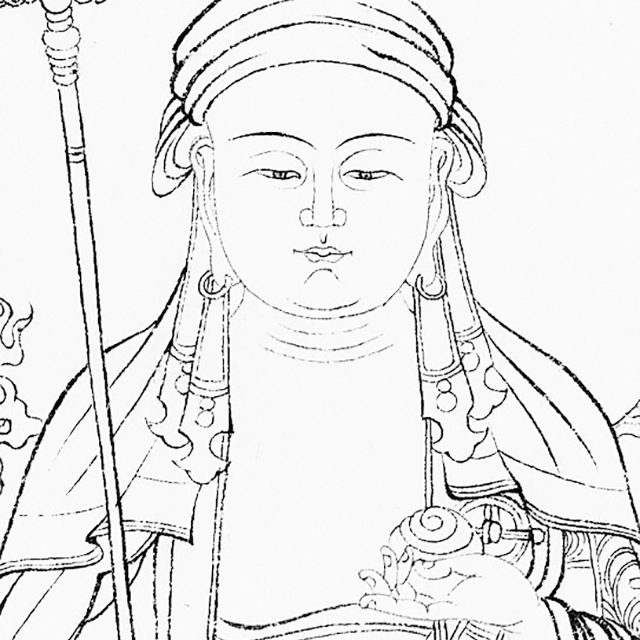
宣公上人講於國際譯經院一九八六年十月十一日
Explained by the Venerable Master Hua on Oct 11, 1986
目犍連譯為採菽氏,本名拘律陀,樹名。父母祈禱此樹而生。與舍利弗同學,互有約言,先得解脫者必告知,共同精進。各率弟子百人,同皈依佛,為常隨眾。
“Maudgalyayana” translates as “descendant of a family of bean gatherers.” He was originally named after a tree, Kolita tree, for he was born after his parents prayed to this tree. He and his fellow cultivator, Shariputra, made an agreement that whoever gained liberation first had to tell the other one. They practiced vigorously together, and each had a hundred disciples. They and their disciples all took refuge with the Buddha and became part of the Buddha’s regular assembly.
尊者事母至孝,知母生前誹謗三寶,又兼殺生,嗜食魚子,死後當墮地獄。以神通力觀察,見其母於餓鬼道受苦,以鉢盛食物供母,物化火燄,母不能食。尊者泣求佛哀愍,救母出苦海。佛令作盂蘭盆供養十方僧,藉此功德,超母生天。
Venerable Maudgalyayana attended upon his mother with great filial piety. He knew that since his mother had slandered the Triple Jewel, killed living beings, and eaten fish eggs during her lifetime she must have fallen into the hells after death. He used his spiritual powers to contemplate his mother’s condition and saw that she was suffering in the path of hungry ghosts. He filled a bowl with food to offer to his mother, but the food turned into flames and she could not eat it. The Venerable One tearfully begged the Buddha to take pity on his mother and rescue her from the sea of suffering. The Buddha instructed him to establish Ullambana offerings to the Sangha of the ten directions, so that, based on this merit and virtue, his mother could be liberated and be reborn in the heavens.
尊者化身大小,降伏毒龍。以鉢盛釋族五百人,送至梵天。神通第一。同舍利弗先佛而入滅。
The Venerable One was able to expand and contract his body to subdue a venomous dragon. He also placed 500 members of the Shakya clan in his bowl and sent them to the Brahma Heaven. He was foremost in spiritual powers. Like Shariputra, he entered nirvana before the Buddha did.
贊曰:A verse in praise says:
事母至孝 皈佛純真
降伏毒龍 搶救釋親
神通變化 般若甚深
盂蘭法會 請求世尊
With utmost filiality, he serves his mother.
With true sincerity, he takes refuge with the Buddha.
He overcomes a venomous dragon
And tries to save the Shakyan clan.
Profound are his spiritual transformations,
Exceptionally profound, his prajna wisdom.
The Ullambana Dharma assembly begins
Upon his request for the World Honored One’s help.
又說偈曰: Another verse says:
至孝救母目連僧 眾生離苦願始伸
盛會解除倒懸業 法筵供養聖賢尊
一切有情皆得度 恆沙餓鬼出獄門
神通第一阿羅漢 緬甸靈跡留古今
The most filial monk, Maudgalyayana, seeks to save his mother.
When all beings leave suffering, his vow will then be fulfilled.
The splendid assembly dispels the karma of hanging upside-down.
A Dharma banquet is offered to the venerable sages and worthy ones.
All sentient beings gain liberation,
And hungry ghosts, many as Ganges’ sands, exit the hells.
He is the Arhat with the foremost spiritual powers.
The miracles in Burma are remembered through the ages.
【淺釋 】Commentary:
今天我們追憶目犍連尊者,加上摩訶兩個字 –– 摩訶目犍連尊者,就是大目犍連。目犍連不是中國話,是梵語,翻譯成中文叫採菽氏,他姓採菽,又有一個名字叫拘律陀。拘律陀是樹名,因為他的父母祈禱樹神,而生目犍連。
Today we are remembering the Venerable Maudgalyayana, and we can add the word “Maha” to his name, so it becomes Venerable Mahamaudgalyayana, or Great Maudgalyayana. Maudgalyayana is not Chinese; rather it is Sanskrit, and it translates as “clan of bean gatherers.” That was his surname. He had another name, Kolita, which was the name of a tree, because his parents had prayed to the tree spirit and then he was born.
目犍連在大阿羅漢裡是神通第一,他顯過種種的神通,做佛的常隨眾。他和舍利弗是同學,以前都是外道,因為舍利弗見到馬勝比丘威儀莊嚴,肅然起敬,就請問馬勝比丘跟那位師父學的。馬勝比丘說:是跟釋迦牟尼佛學的。那時舍利弗和目犍連已經做外道的老師,每人有一百多位弟子和他們學習外道法。可是他們全皈依佛,做佛的弟子,跟佛學佛法。他和舍利弗修行互相有約言說:我們無論誰得到解脫,一定要互相告訴,不能自己衹顧自己。所以這才是真正的同學,真正的同參道友,也是真正的朋友。他們皈依佛之後,做佛的常隨眾,時時學習佛法。舍利弗是智慧第一,目犍連是神通第一。他的神通,一般的阿羅漢亦不能和他比,所以在聲聞裡,他是一位很重要的阿羅漢。他非常精進學習,和舍利弗共同修行,互相鼓勵幫助,互相取長補短,互為借鏡,互相勉勵,所以倆人的功夫突飛猛進。
Among the great Arhats, Maudgalyayana was foremost in spiritual powers. He displayed all manners of spiritual powers and was among the disciples who always followed the Buddha. He and Shariputra were fellow cultivators. Previously, they had both followed a non-Buddhist religion. When Shariputra saw the Bhikshu Asvajit’s dignified deportment and adorned appearance, he respectfully asked him who his teacher was. Bhikshu Asvajit replied, “I study with Shakyamuni Buddha.” Shariputra and Maudgalyayana were already leaders of their religions, and each had over a hundred disciples studying their heterodox teachings. Now, however, they all took refuge with the Buddha, became the Buddha’s disciples and studied the Buddhadharma from the Buddha. As they cultivated, he and Shariputra made a deal with each other, saying, “No matter which one of us becomes liberated first, that person must tell the other one and not just look after himself.” This showed that they were truly fellow cultivators and companions in the Path, as well as genuine friends. After taking refuge with the Buddha, they were among the disciples who always followed the Buddha around and studied the Buddhadharma. Shariputra was foremost in wisdom, whereas Maudgalyayana excelled in spiritual powers. Ordinary Arhats’ spiritual powers could not compare with his. That’s why he was a very important Arhat among the Hearers. He studied with exceptional vigor. He and Shariputra cultivated together, mutually encouraging and helping each other. They would learn from each other’s strengths and weaknesses and urge each other to improve. For that reason, they were both able to advance rapidly and develop their skills in cultivation.
目犍連對母親很孝順。他母親死後,他就知道他母親應該墮地獄,因為他母親在生時不信三寶,誹就是無理取鬧,吹毛求疵,以是為非,以非為是;以黑為白,以白為黑,顛倒是非,曲直不分,顛倒陰陽,錯亂因果。他母親又歡喜殺生,歡喜吃魚卵,雖然魚卵還沒成魚形,這都是魚的因,都有生命的。她在魚卵還沒成魚的時候,都把它吃了,所以這個罪業更重,這能造成癌症之類等病痛。在活的時候不受苦,死了之後也會受苦的。
Maudgalyayana was extremely filial to his mother. After his mother died, he figured that she had fallen into the hells, because when she was alive, she did not believe in the Triple Jewel, but rather caused trouble and was very critical of Buddhism. She mixed up right and wrong, black and white, crooked and straight, yin and yang, and made mistakes in cause and effect. His mother was also fond of killing, and eating fish eggs. Although the fish eggs had not developed into fish, they were future fish and had life to them. She ate all these fish eggs before they had developed into fish, and so her karmic offenses were very heavy and could have led to illnesses such as cancer. Even if she didn’t suffer when she was alive, she would suffer after death.
他勇猛精進修行,想要知道他母親死後的情形,有一天他剛剛得了六種神通(天耳通、天眼通、他心通、宿命通、漏盡通、神足通),他用神通力觀察他母親已經墮落到餓鬼道裡天天餓得非常難受,可是沒有東西吃。
Maudgalyayana cultivated very vigorously hoping to find out how his mother was after she died. One day, after he had just attained the six spiritual powers (the power of the heavenly ear, the power of the heavenly eye, the power of knowing others’ thoughts, the power of knowing past lives, the power of freedom from outflows, and the power of the complete spirit), he used his spiritual powers and observed that his mother had fallen into the path of hungry ghosts and was extremely famished with nothing to eat every day.
為什麼她沒有東西吃?因為業力的感召,無論什麼食物到她口裡,就會變成火燄來燒她。目犍連看見母親墮落到餓鬼道,沒有東西吃,便用缽裝滿吃的東西,到地獄裡想要給他母親吃,想不到他母親的業力重於他的孝念,她用手抓著食物往口裡吞,就變成火燄。目犍連看自己雖有大神通,也無法救母親,於是哀泣跪求於佛。佛說:你母親所犯的罪業不是你一個人的力量可以救得了。因為你母親的罪業深重,必須在七月十五日,設盂蘭盆供上各種的飲食、臥具、湯藥供養十方賢聖僧,以十方賢聖僧為她迴向的力量,便可以超度你母親升天。
Why did she have nothing to eat? Due to her karma, no matter what food she put in her mouth, it would turn into flames and burn her. When Maudgalyayana saw his mother suffering in the path of hungry ghosts with nothing to eat, he filled a bowl with food and went to the hells to give it to her to eat. What he had not counted on was that his mother’s karma was stronger than his filial piety. When his mother grabbed the food with her hand and put it into her mouth to swallow, it turned into flames. Maudgalyayana saw that although he had great spiritual powers, he had no way to save his own mother. Thus, he tearfully knelt before the Buddha to plead for help. The Buddha said, “Your mother’s offenses are such that you alone do not have enough power to save her. Because her karma is so heavy, on the fifteenth day of the seventh lunar month, the Day of the Buddha’s Rejoicing and also the day of the Sangha’s Pravarana, you must set up Ullambana basins with all kinds of food, drink, bedding, and medicines to offer to the holy Sangha of the ten directions. Relying on the strength of the transference of merit made by the holy Sangha of the ten directions on behalf of your mother, she will be liberated and be reborn in the heavens.”
從四月十五日至七月十五日之間,修道人不到各處去,這叫結夏安居。結夏就是停止一切的活動,安居就是安然居住,不到外邊去化緣,固定在一個地方居住,當然在道場裡仍然會繼續講經說法。出家人結一個夏才算增加一歲,沒有結夏安居就沒有多活一歲,這又叫僧臘。佛告訴目犍連若要救母親,必須在七月十五日--佛歡喜日,(佛於這一天生歡喜),僧自咨時,(僧人這個時候互相訴說自己在這三個月期間有什麼境界及經驗,互相檢討一下,無拘無束的談話討論問題,所以這叫自咨),目犍連尊者依教奉行,按著這種方法設盂蘭盆供,並仗此功德救母出離地獄。
From the fifteenth of the fourth lunar month to the fifteenth of the seventh lunar month, cultivators refrain from traveling. This is called the summer retreat. During the summer retreat, all activities are stopped and cultivators dwell peacefully in one place. They do not go out on alms rounds, but just stay in a fixed place. Of course in the monastery, they continue to lecture sutras and speak the Dharma. It is only after doing a summer retreat that a monastic gains one year in the Sangha. If one does not do the summer retreat, one does not gain a year. This is one’s age in the Sangha. The Buddha told Maudgalyayana that if he wanted to rescue his mother, he had to do the Ullambana offering on the fifteenth day of the seventh month, which is the day when the Buddha rejoices, and also the day when Sangha members mutually share and discuss their experiences during the past three months, and evaluate their own practice. Sangha members very openly and freely discuss these issues. Maudgalyayana did as the Buddha instructed and established the Ullambana offerings, the merit and virtue of which enabled his mother to leave the hells.
目犍連尊者降伏毒龍,這個毒龍障礙佛說《地藏經》,因為佛要到忉利天為他母親說法,這個毒龍在須彌山中間噴毒沙擋佛,目犍連和毒龍鬥法,結果牠被降伏,也皈依佛了。目犍連和舍利弗兩位尊者知道佛快要入涅槃,就先走一步,不願意自己親眼見到佛入涅槃的境界,所以他們兩位先佛而入滅。在佛未入滅以前,他們就先跑了。這是簡略的介紹目犍連,若是詳細的說他的神通妙用,有說不完那麼多,因為現在文字、時間有限,所以簡單地說。
Maudgalyayana subdued a venomous dragon which tried to prevent the Buddha from speaking the Earth Store Sutra. The Buddha wanted to go to the Trayastrimsha Heaven to speak the Dharma for his mother, but halfway up Mount Sumeru, this venomous dragon spit poisonous sand to block the Buddha. Maudgalyayana engaged in a Dharma battle with the venomous dragon, and in the end the dragon was subdued and took refuge with the Buddha. When Venerable Maudgalyayana and Venerable Shariputra found out that the Buddha was about to enter Nirvana, they entered Nirvana before the Buddha did, because they could not bear to witness the Buddha entering Nirvana — before the Buddha entered Nirvana, they departed first. This is a brief introduction to Maudgalyayana. If I were to explain the wonderful functions of his spiritual powers in detail, I would not be able to finish. Since language and time are both limited, I will just give this simple explanation.
贊曰:A verse in praise says:
「事母至孝」:他侍奉母親非常孝順。至孝就是再沒有比他更孝順的,所以他一得到神通,就想要救他母親。
「皈佛純真」:他皈依佛之後,很真心純意,一點也沒有三心兩意,他專一其心學佛法。
Commentary:
With utmost filiality, he serves his mother. He was extremely filial to his mother, to the point that there could be no one more filial than him. That’s why, as soon as he attained spiritual powers, he wanted to rescue his mother.
With true sincerity, he takes refuge with the Buddha. After he took refuge with the Buddha, he very sincerely and wholeheartedly, without any doubt or hesitation, took up the study of the Buddhadharma with single-minded concentration.
「降伏毒龍 」:他又能把毒龍降伏住。他搶救琉璃大王滅釋種。琉璃大王和釋種有互相殘殺的血戰,所以要血債血還。「搶救釋親」:在往昔琉璃大王是在水池裡的一條魚王,率領魚鱉蝦蟹之類的眷屬在河裡生存。住在河邊的村人都歡喜吃魚,所以把魚的種類都吃完了,最後把魚王也捕來吃,這是在很久很久以前的事情,當時釋迦牟尼佛也在那兒玩,看到這麼大一條魚,就用一根棍子,在魚的頭上打了三下。釋迦牟尼佛在因地打過這條魚,這條魚王就生出憎恨心,將來要報仇,因此釋迦牟尼佛成佛之後,頭痛了三天也就因為打魚三棍子,所以才有金槍馬麥之類的果報,因為這個因緣,琉璃大王--魚王,帶著他的眷屬,把從前吃牠這些人的種族都要殺光。
He overcomes a venomous dragon, and tries to save the Shakyan clan. He tried to save the Shakyan clan when King Crystal was seeking to annihilate them. King Crystal and the Shakyan clan had been engaged in a blood feud, and debts of blood had to be repaid with blood. In a past life, King Crystal had been a king of fish in a pond, and his subjects were fish, turtles, shrimp, crabs. He and his retinue of fish lived in the river. The people in the village next to the river loved to eat fish, so they ate all the fish in the river, and finally they even caught the fish king. This happened a long, long time ago, and at that time Shakyamuni Buddha was also there playing. When he saw that huge fish, he took a stick and hit the fish on the head three times. The Buddha hit this fish in the formative stages of his cultivation, and this king of fish gave rise to hatred and vowed to seek revenge. Therefore, after Shakyamuni Buddha became a Buddha, he suffered a three-day headache because he had hit the fish three times. This is similar to the other two well-documented retributions that the Buddha also had to undergo — being injured by a spear and being offered horse-feed. Due to these past circumstances, King Crystal, the former fish king, led his retinues to annihilate those people who had eaten him in the past.
目犍連當時請求佛救釋族,我相信釋迦牟尼佛當時不會違背因果來救釋種,所以目犍連用他的缽盛釋族五百人送到天上去避難,等災難過去再把他們請回來,這種思想是有道理的,但是他還不明白前因後果。如果當時釋迦牟尼佛和他說明:這是因果,我不能救。我相信目犍連尊者也不會救的,為什麼呢?如果他再救,一、他不聽佛說的法。二、他不信因果。所以我認為當時佛是默然,他就誤會以為佛不自私,不救自己的種族,而等弟子來救,所以他很奮勇的把釋種送到天上,想不到在天上也一樣化為一盆血水,也沒有救成,這是定業不可轉,這是眾生的一種業力,就是阿羅漢也不可不講因果。
At that time, Maudgalyayana begged the Buddha to save the Shakyan clan. I believe Shakyamuni Buddha could not go against the workings of cause and effect to save the Shakyans. Maudgalyayana placed 500 Shakyans in his almsbowl and sent them to the heavens to escape this disaster. After the calamity was over, he brought them back. Although his idea seemed good, he didn’t understand the law of cause and effect. If Shakyamuni Buddha had explained to him at the time and said, “This is cause and effect. I cannot save them,” I believe that Maudgalyayana would not have tried to save them, either. Why not? Because if he did try, first, he would not be listening to the Buddha’s Dharma, and second, he would not believe cause and effect. Therefore, I think that at the time the Buddha kept silent, and Maudgalyayana mistakenly thought that the Buddha was being unselfish in not saving his own clan and that it was up to his disciple to save them. That’s why Maudgalyayana bravely sent the Shakyans to the heavens. He never expected that in the heavens, they would still turn into a pool of blood and could not be saved. This shows that fixed karma cannot be changed. This is the power of living beings’ karma, and even Arhats cannot ignore cause and effect.
「神通變化」:他的神通變化是不可思議的,一般人是不能完全懂。「般若甚深」:他的智慧也是很高的。
「盂蘭法會」:盂蘭是梵語,翻譯成中文叫解倒懸,就是人犯罪犯得太大了,就把他倒著吊起來,是很難受的刑法。因為尊者母親受苦,所以他「請求世尊」,佛為他說盂蘭法會能解救他母親倒懸的罪業。
「請求世尊」:請求釋迦牟尼佛。
Profound are his spiritual transformations. The transformations of his spiritual powers were inconceivable; ordinary people could not entirely fathom them.
Exceptionally profound, his prajna wisdom was very lofty.
The Ullambana Dharma assembly begins, upon his request for the World Honored One’s help. Ullambana is Sanskrit and is translated as “rescuing those hanging upside-down,” i.e, when people’s offenses are too severe, they would suffer as if hung upside-down. It is really an unbearable punishment. Since the Venerable One’s mother was suffering, he asked the World Honored One, Shakyamuni Buddha, for help, and the Buddha told him that an Ullambana Dharma assembly could rescue his mother from the karmic offenses that made her be as if hanging upside-down.
又說偈曰: Another verse says:
「至孝救母目連僧」:他是一個很孝順的出家人。
「眾生離苦願始伸」:等到眾生都離苦得樂了,他的願力才算伸展,滿他的願。
「盛會解除倒懸業」:盂蘭法會是一個盛會,能解除眾生倒懸的罪業。
「法筵供養聖賢尊」:設盂蘭盆供養十方的聖賢尊。
Commentary:
The most filial monk, Maudgalyayana, aspire /seeks to save his mother. He was a very filial monastic. When all beings leave suffering, his vow will then be fulfilled. His vow will only be realized when all beings have found happiness.
The splendid assembly dispels the karma of hanging upside-down. The splendid Ullambana Dharma assembly can liberate beings from the karmic offenses that cause them to be as if suspended upside-down.
A Dharma banquet, the Ullambana, is offered to the venerable sages and worthy ones of the ten directions.
「一切有情皆得度」:所有的眾生都因為這個法會而得到度脫。
「恆沙餓鬼出獄門 」:恆河沙數那麼多的餓鬼,都離開地獄門,離苦得樂升天去了。
「神通第一阿羅漢」:在小乘裡他是神通第一,他和菩薩當然不能相比。阿羅漢也是梵語,翻譯成中文叫應供、殺賊、無生。因為多含不翻,三個意思,所以保留阿羅漢原名。應供,應受人天的供養。殺賊,殺眾生的無明煩惱賊。無生,他已經悟得無生法忍,不生不滅,不垢不淨,不增不減的境界,所以叫阿羅漢。
「緬甸靈跡留古今」:摩訶目犍連尊者曾經在緬甸顯過神通。在緬甸有個地方有兩塊石頭,底下有塊大約幾噸重的大石頭,上面又有一塊像桃子或葫蘆的石頭,這有什麼出奇?怎麼叫顯神通呢?雖然底下這石頭那麼重,可是兩人可在石頭底下用細繩往兩邊拉,一拉可從左邊拉到右邊,從右邊又可拉到左邊,這證明這石頭還在虛空裡懸著,這叫目連尊者顯神通,所以緬甸信佛的人很多,這和目犍連都有關係。因此在緬甸造了一個大金塔,一般佛教徒都不遠千里去朝拜大金塔,這些事情說來都很不可思議。
By virtue of this Dharma assembly, all sentient beings gain liberation, and hungry ghosts, many as Ganges’ sands, exit the hells and are reborn in the heavens. He is the Arhat with the foremost spiritual powers. Although he is foremost in spiritual powers in the Lesser Vehicle, he cannot compare to Bodhisattvas. “Arhat” is Sanskrit and translates as “worthy of offerings,” “slayer of thieves,” and “unborn.” Since it has three meanings, it is kept in Sanskrit and not translated. “Worthy of offerings” means he is deserving of offerings from humans and gods. “Slayer of thieves” means he slays living beings’ thieves of ignorance and afflictions. He is “unborn” because he has already awakened to and attained patience with the nonarising of dharmas or phenomena, wherein he sees that phenomena neither arise nor cease, are neither defiled nor pure, neither increase nor decrease. Thus he is known as an Arhat.
The miracles in Burma are remembered through the ages. Venerable Maudgalyayana displayed his spiritual powers in Burma. In Burma there’s a place with two stones–an enormous stone that probably weighs several tons, on which sits a small stone shaped like peach or a gourd. What’s so special about that? How is this a manifestation of spiritual powers? Although the bottom stone is very heavy, two people standing on either side on the stone could use string to pull the stone from left to right, and from right to left, showing that the stone is suspended in mid-air. This is a manifestation of the Venerable Maudgalyayana’s spiritual powers. The fact that there are so many Buddhists in Burma has to do with Maudgalyayana. A golden pagoda was built in Burma because of this, and Buddhists travel thousands of miles to make a pilgrimage to this pagoda. When we speak of it, this sounds pretty inconceivable.♦